

Time to Read: 4 mins
I’ve been loosely following the World Cup. ⚽️ I say “loosely” because I often start watching a match and then suddenly find myself falling down a curiosity-fueled rabbit hole, researching the lives and backgrounds of various coaches and players.
Yesterday, it was Didier Deschamps, France’s coach. And even though their run in the ‘26 World Cup has come to an end, his backstory is worth knowing…
In 1998, France won its first World Cup. Deschamps, their captain and a defensive midfielder at the time, held the trophy in the air while his teammates soaked him with water bottles.
He wasn't the star of that team (though, keep in mind, he was the captain).
Zinedine Zidane was actually the star. But Deschamps ran, tackled, and passed the ball to Zidane, contributing to Zidane’s success.
Deschamps’ nickname, as a result, was le porteur d'eau. Translation: the water carrier. It was meant to be an insult. To serve as a reminder that his role was to fetch the ball for the players who actually mattered.
But what’s interesting is that Deschamps actually saw the title as a gift, not a jab!
He viewed his “support” status as a strength to be leveraged, not a lower-status position to be embarrassed by. He didn’t need to be perceived as the most valuable player in the room. And because of that, he would go on to achieve so much more.
Asked about it years later, he shared some really important wisdom. "A water carrier? Yes, that's exactly what I am," he said. "Great teams are not just created by the architect, but also by bricklayers and hod carriers." (Cue the next rabbit hole… what is a hod carrier? 🤨)
Deschamps looked at what he did well and took note of his strengths. His precision tackles, his ability to recover the ball, the laser-focused passes that kept the offense moving forward… he decided that was the job.
He wasn’t a lesser version of a “real” player because he didn’t score the goals; he was part of the system that made the team win, and those players shine.
He was there to help others be their best. Then and now.
An admirable quality, for sure. But for many, it's far easier said than done.
We say we want to build strong teams, capable people, and leaders who don't need us. But yet, often, some quiet part of us is still vying to be the most valuable person in the room.
And that need, no matter how small, has a much higher cost than is often realized. Because… it takes growth opportunities away from those we support.
I see it every day in my leader development work, and I studied it at great length in my dissertation, which is why I was so intrigued and inspired to learn more about Deschamps, and so quick to fall down this rabbit hole.
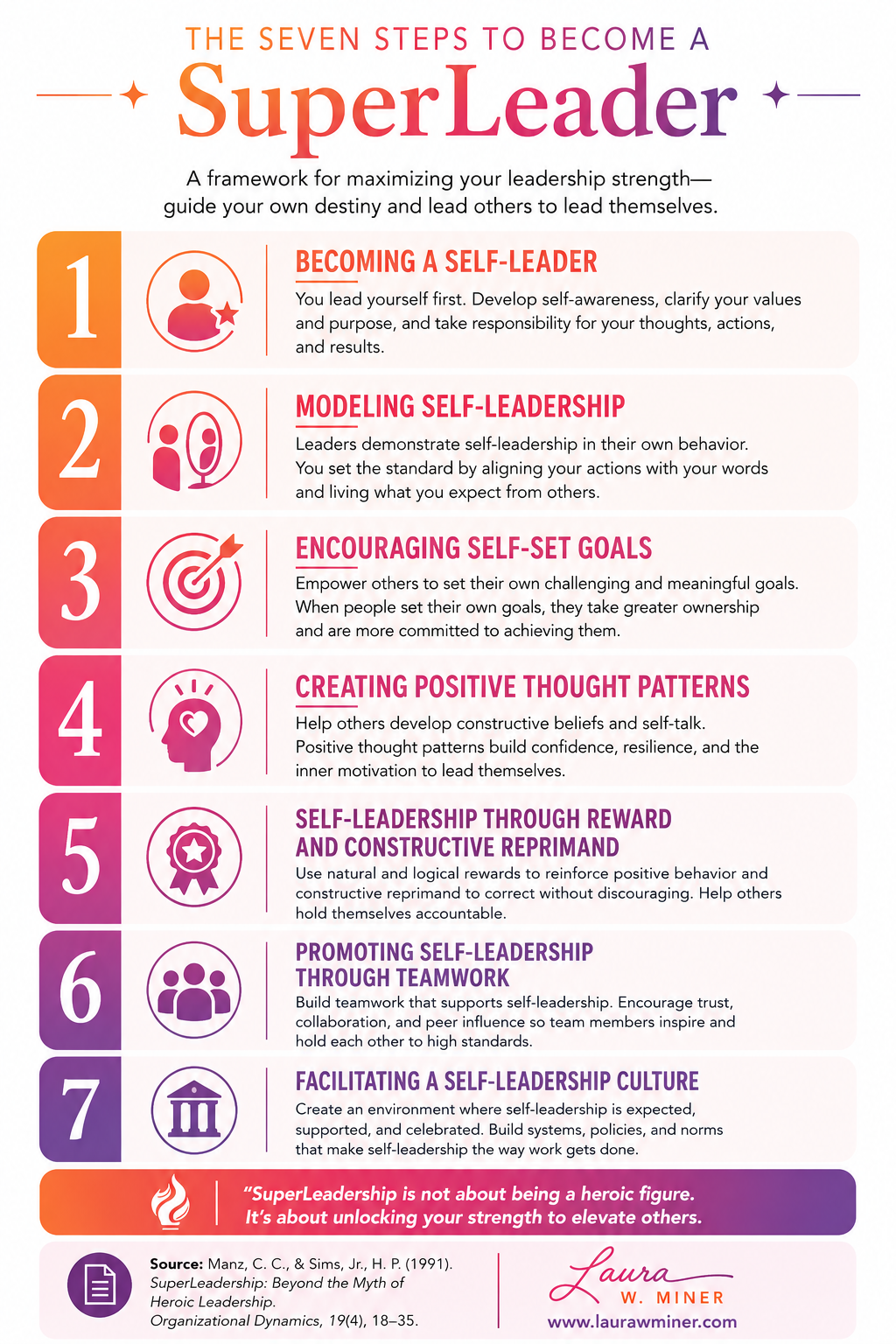
There's a name for what Deschamps did, and it comes from a 1991 paper by management researchers Charles Manz and Henry Sims Jr., who studied what separates leaders who build lasting organizations from leaders who just run them.
They called it SuperLeadership. (Dumb name, IMO, but important insights!)
Their first finding was the importance of self-leadership. As their research showcased, if you want to lead somebody else, the first step is to lead yourself. (Yes! Self-Leadership for the win! 🙌 )
This piece was critical because it’s only after you learn to effectively lead yourself that the second step becomes possible: modeling it for others.
Their research highlighted that telling others how to lead wasn’t nearly as effective as being the example that shows them how to lead.
Deschamps modeled the way long before he formally became the leader. And as the formal leader, he’s a phenomenal example of someone who intentionally works to develop self-leadership in others.
Watch France in action and you’ll see it unfold in real time.
Once a match starts, by his own account, Deschamps steps back. He empowers the players on the field to read what's happening and solve it themselves, the same way he once did as a player.
It's the same water carrier. Just twenty years later, doing it on a bigger stage in a larger way.
All while serving as a brilliant lesson for the rest of us.
💡 Practionable Takeaway
Spend a few days paying attention to those little moments where you're unintentionally taking growth opportunities away from others. Situations like…
➡️ The meeting where you jump in with the answer before anyone else gets the chance to find it.
➡️ The client call you take over rather than letting the sales rep find their way through it.
➡️ The presentation you decide to give instead of watching someone struggle and grow through it.
Then, when you catch it in action, challenge yourself to sit on your hands.
Literally count to five before you speak. Let someone else take the swing, even if you already know they'll fumble it a little.
That fumble is their growth opportunity. It's the same one Deschamps hands his players every time he stays on the sideline instead of stepping onto the field. And it’s what propels his team to greatness.
🎥 Want to Go Deeper?
Given this is a newsletter and not a book, I only wrote about two SuperLeadership steps for Deschamps: lead yourself, then model it for others.
But those two steps are part of a bigger arc, one that takes you all the way from leading yourself to building a culture where everyone around you leads themselves too.
Here's that whole map, step by step. And if you want to chat about implementing this personally or bringing it to your organization, you know where to find me.
To Your Success,
Laura 💜🧡





Responses